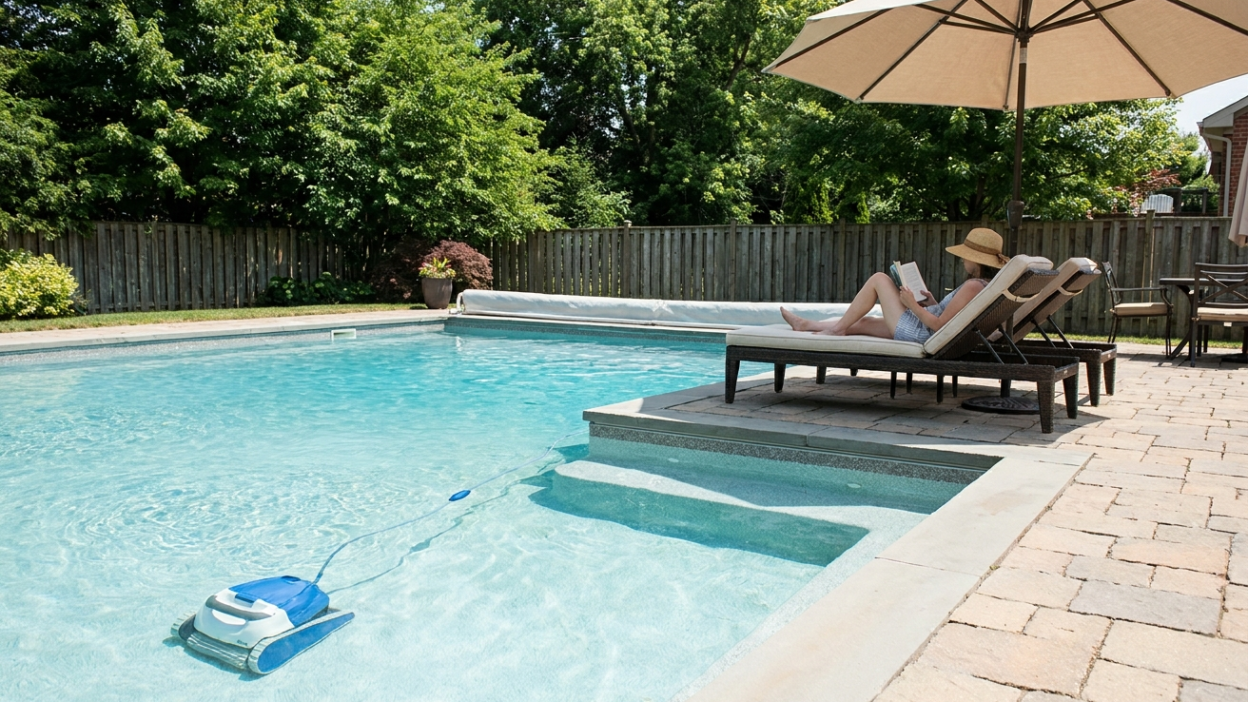
Before you add a robotic cleaning device to your pool, maintenance is a physical task. You skim, you brush, you vacuum, you test, you add chemicals. It takes thirty to sixty minutes per session, and it happens multiple times per week. The work is not difficult, but it is repetitive and it never ends.
After you own one, the routine shifts from physical labor to monitoring. The machine handles the debris removal. You handle the chemistry. The total time commitment drops from several hours per week to less than one. The change is not incremental. It is qualitative.
What the Machine Replaces
A robotic cleaner handles three tasks that previously required manual effort: floor vacuuming, wall brushing, and surface skimming of submerged debris. It does not replace skimming floating debris from the surface, which still requires a hand skimmer or an automatic surface skimmer. It does not replace chemical testing or adjustment.
The time savings come from eliminating the vacuuming step, which is the most time-consuming manual task. Manual vacuuming requires connecting hoses, setting up the vacuum head, and slowly pushing it across the entire floor. For a typical residential pool, this takes thirty to forty-five minutes. A robotic cleaner does the same work in one to two hours, but requires zero active participation from the owner.
The key shift is from active time to passive time. Manual vacuuming demands your attention for its entire duration. Robotic cleaning runs while you do something else. The pool gets cleaned, and your schedule stays open.
What Changes in Chemical Management
Pools that are cleaned regularly by a robotic device tend to need less chemical intervention. The reason is straightforward: physical debris removal reduces the organic load in the water, and lower organic load means less chlorine is consumed by oxidation.
Leaves, insects, and organic sediment that sit on the pool floor decompose and consume chlorine as they break down. A cleaner that removes this debris daily, before significant decomposition occurs, preserves chlorine levels and reduces the frequency of shock treatments.
The effect is most noticeable during peak debris season. Pools surrounded by trees that drop leaves and seeds regularly see the biggest reduction in chlorine consumption after adding a robotic pool cleaner to their routine, because the debris is removed before it has a chance to affect the water chemistry.
What Changes in Filter Maintenance
The pool’s main filter system benefits from reduced debris load. When organic material is captured by the robotic cleaner’s internal filter instead of being drawn into the main pump and filter, the main filter loads more slowly and requires less frequent backwashing or cartridge cleaning.
This extends the life of the main filter media and reduces the water waste associated with backwashing. In sand filter systems, the savings can be significant during leaf season, when manual vacuuming sends large volumes of debris through the main filter.
The trade-off is that the robotic cleaner’s own filter requires regular cleaning. This is a smaller, easier task than cleaning the main filter, but it is a new task that did not exist before. The net effect is still a reduction in total maintenance effort, because the robotic filter is designed for easy access and quick cleaning.
What Changes in Brushing Frequency
Robotic cleaners with active scrubbing brushes reduce the frequency of manual wall brushing. The brushes agitate the wall surface as the cleaner climbs, removing the thin film of biofilm and algae spores that accumulate between cleanings. This is not a complete replacement for manual brushing, but it extends the interval between brushings significantly.
Pools that required weekly wall brushing before adding a cleaner typically need manual brushing only once every two to three weeks afterward. The cleaner handles the routine maintenance, and manual brushing becomes a periodic deep cleaning rather than a weekly chore.
The exception is the waterline, where body oils and sunscreen accumulate. No robotic cleaner scrubs the waterline as effectively as a person with a tile brush. Plan to brush the waterline manually every two to three weeks, regardless of whether you own a cleaner.
What Does Not Change
Chemical testing still requires your attention. The cleaner removes physical debris but does not measure or adjust water chemistry. Testing twice a week remains the minimum, and more frequent testing is necessary during heavy use, after rainstorms, and during heat waves.
Surface skimming for floating debris is still a manual task. Leaves, insects, and pollen that float on the surface must be removed with a hand skimmer or managed with an automatic surface skimmer. The robotic cleaner operates underwater and does not address surface debris.
Equipment maintenance — pump basket cleaning, filter backwashing, and pump seal lubrication — remains unchanged. The cleaner reduces the debris load on these systems but does not eliminate the need for regular equipment maintenance.
The Real Routine After Ownership
A typical week with a robotic cleaner looks like this. Deploy the cleaner two to three times per week, which takes two minutes each time: place it in the pool and press start. After each cycle, remove it, rinse the filter, and set it aside. Total active time: ten to fifteen minutes per week.
Test chemistry twice per week, which takes five minutes each time. Adjust as needed, which takes another five minutes. Brush the waterline every two to three weeks, which takes ten minutes. Total active time for chemistry and brushing: twenty to thirty minutes per week.
Combined total: thirty to forty-five minutes of active maintenance per week, compared to two to three hours without the cleaner. The time savings are real and consistent. The pool stays cleaner, the chemistry is more stable, and the physical effort is minimal. The routine does not disappear, but it transforms from a demanding physical task into a light monitoring responsibility.